Showing posts with label White-throated Sparrow. Show all posts

Monday, May 9, 2011

Keeping up with the Changes

Ah, early May -- the birder's favorite time of year, when there are lots of migrants returning or at least passing through, and the leaves are not yet out on the trees so one can actually see the birds without a lot of hunting! Today, without trying and with hardly going outside the house, I tallied 26 different species. Some of these are The Regulars, but that's still a pretty decent total.

We've had a good variety of warblers bopping around the trees on the edge of the yard, but even without full foliage there have been several that I've been unable to identify, simply because they dart around so much. But right around the house we've had Blackburnian, Black & White, Yellow-rumped, Chestnut-sided, Black-throated Green, Palm, and an American Redstart. If I include the area down by the river I can add Yellow Warbler and Common Yellowthroat to the count. I was particularly pleased to see the Redstart this morning. I note that the first one we saw at this house was on May 8, 2010. As Sally said when I pointed this out: "Punctual little sucker, ain't he?" Last year some Scarlet Tanagers had shown up by this time but I've not seen any yet this year. Yet.

All the colorful returnees that I reported on in my previous post are still around. The male Baltimore Oriole has been joined by a "first spring" female so, perhaps with a bit of luck, they'll decide to take up nest-keeping in the area. The Rose-breasted Grosbeaks are chasing each other around the yard and woods, presumably with amorous intent.

We were very pleased to hear our first thrush of the year singing yesterday morning as we retrieved the Sunday papers from the end of the drive. I think it was most likely a Hermit Thrush, like the one pictured in the header to this blog, but I'm not certain. After hearing it we promptly gave ourselves a refresher course in distinguishing thrush songs, but since then I've not heard him singing again to confirm his identity.

The downside of the seasonal change is that birds that were around all winter have now departed. I've not seen and Juncos for a couple of weeks now, and Red-breasted Nuthatches are likewise among the missing.

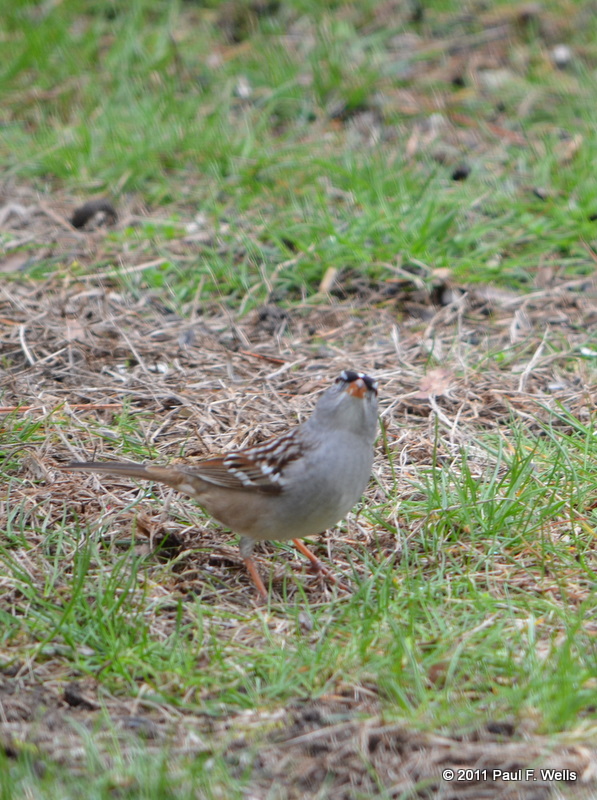
Tree sparrows are also becoming scarce, though I seem to recall that last year we had some around through the summer. On the other hand, a couple of White-crowned Sparrows were in the yard last Thursday, May 5, though I've not seen them since. I did manage to get a few photos of one, including one of him together with one of the many White-throateds we have so the differences between the two are easy to spot:


"See, I've got a pretty white throat..."

"...and you don't!"

There are three or four Gray Catbirds around, and are very active and very vocal! We had a pair or two nesting around here last year, and we hope they take up residence again. They seem to be hanging out in a brushy area on the northeast side of the house, which looks like textbook Catbird habitat to me! But what do I know. They're quite happy to help themselves to the orange halves that I put out for the Orioles:


They also love to feast on suet:


The Ruby-throated Hummingbirds are also still coming around, and I managed to get a couple of shots that are somewhat better than those in the previous post:


Blue Jays are with us all year, of course, but their numbers have gone up noticeably in the past week or two. I haven't bothered to count, but whereas there are usually three or four around, there's at least twice that many now. I fear that I've tended to overlook them in terms of photography, but they really are handsome birds and deserve to have their picture taken occasionally!


The local mammals are more active again, too. Chipmunks were largely absent through the winter, but have resumed their scampering around the yard, and have dug a few new holes in the lawn and under steps. Hmmmm.


Finally, right after hearing the thrush singing yesterday we noticed something large and furry in one of the small trees in the woods near the garage. "What the...????" Turns out it was a chunky porcupine, who gave the impression that he was sleeping off a bender from the night before:


His impressive, orange-colored incisors are clearly visible in the last photo if you click on the small image and pull up a larger copy. One has to wonder why he chose this particular tree in which to catch up on his beauty sleep. It seemed barely stout enough to hold him, and it didn't look particularly comfortable! But what do I know. He was largely unperturbed by the process of having his picture taken and remained asleep all the while. He finally sauntered off sometime while we were having breakfast, though I missed seeing him climb down.

There were many old apple trees on the farm where I grew up, including several right around the house. Once they began to bear fruit each year the trees were magnets for porcupines! The family dog would usually take exception to their presence, often resulting in an encounter in which the dog ended up with a nose full of quills. One of my older brothers remembers a cow getting quilled on at least one occasion, but that must have been before my time.

Porkys don't shoot their quills, as is sometimes believed. However, the quills are attached very loosely and are dislodged quite easily. Writing of the porky's ability to defend itself, Alfred J. Godin, in Wild Mammals of New England (1977) notes: "A cornered porcupine erects its quills, tucks its head between its front legs or under a protective object, turns its rear to the adversary, and rapidly swings its tail or makes a rolling lunge of the body." Given that porcupines' top forward speed is only around two miles per hour they clearly need some sort of defense mechanism.

Tuesday, April 26, 2011

The Changing of the Sparrows and other Markers of the Season

The huge piles of winter snow have now vanished, and though our weather here in southern Maine is still pretty chilly, Spring has, in fact, sprung. More or less. This means, of course, that migration season is underway; the Maine birds e-mail list is buzzing with reports of first-of-year this and first-of-year that. I'm experiencing a bit of warbler envy as very few of the colorful, peripatetic little critters have yet shown up in my trees, though others around the state are reporting Palms and Pines and such. It's not a total warbler wasteland around here--I spotted a Palm in the brush along the driveway yesterday and as I write this I've been distracted by a male Yellow-rump that's been bopping around the trees outside my office window. I imagine that more will show up in due time. There have been numerous other seasonal returnees, and even a couple of new yard birds, to keep things interesting.

I'm especially happy to have White-throated Sparrows back with us. I noted the first one of the year on April 12, and he or she was soon joined by others. They were around for a few days before I heard any of them singing, but now the welcome sounds of "George Peabody, Peabody, Peabody" have been added to the mix of songs that accompany me as I go out to retrieve the papers of a morning.


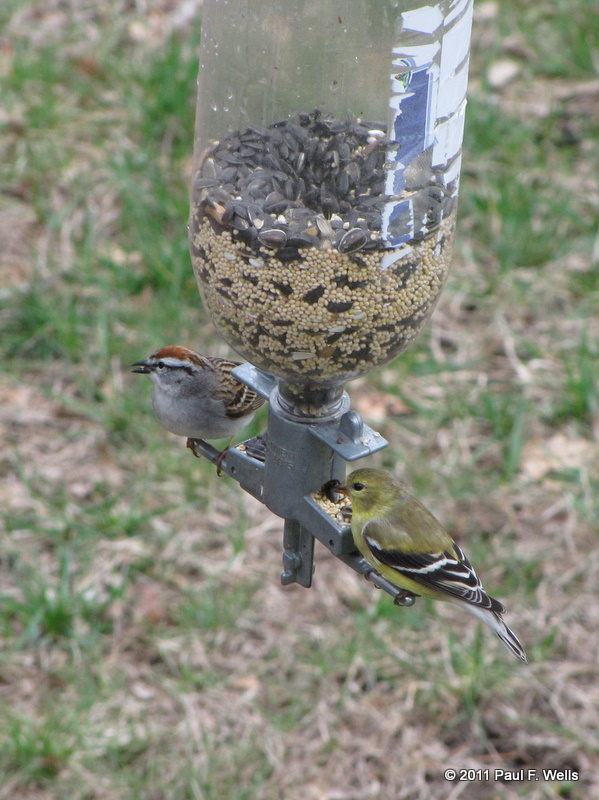
Their cousins the Chipping Sparrows have returned as well; I noted the first one in the yard on April 16. I find it to be a bit of a challenge sometimes to distinguish Chippies from the Tree Sparrows that have been with us through the winter, and that seem to be year-round residents here. Although Chippies have a distinctly white eye stripe and the Trees have a gray one, in certain light and at certain distances I often have to resort to binoculars to be sure which species it is that I'm seeing.

Chipping Sparrow with female Goldfinch

The female Goldfinch in the photo is just one of many that are still around. The males have almost, but not quite, finished making their transformation from their muted winter colors to the spectacular yellow of summer, and are bringing some welcome zing to our feeders.

Regrettably, pretty much coincidental with the arrival of the White-throats and the Chippies was the departure of the Fox Sparrows that graced us with their presence through late March and early April. I noted a high count of five on April 6, but that was almost the last time I saw any. It was always a treat to look out and see them scratching on the ground, looking for something good to eat. We hope they found enough to their liking that they'll return next year!
 
I'm delighted, if a bit surprised, to note that Juncos are still around in abundance. I'm still learning the rhythms of the seasons here in Maine, but it's unlikely that the "Junkets" will be with much longer. I noted their arrival last October and they have delighted us all winter. We'll enjoy their presence as long as they care to stick around!


We've had a few Purple Finches around since April 19. There quite a few here in late summer and early fall last year, and I'm happy to see some back with us.

 
Back in January I noted the presence of a Brown Creeper in the yard. I was pleased that we had at least two around all winter, often joining the Downy Woodpeckers and others at our suet feeders. I've not seen them much recently, but was happy to see one yesterday, April 25.

Downy Woodpecker and Brown Creeper

Flickers have been back for several weeks now, though they're skittish enough that I've not been able to get any photos of them. I was extremely pleased to see a Yellow-bellied Sapsucker here on April 5--a new yard bird for us here!


I've not seen her too often, so perhaps she's moved on through. I'd like to think that she'll find a partner--if she doesn't already have one--and set up housekeeping in our woods. We get occasional looks at a pair of her big cousins, the Pileateds, so together with the Downies, Hairies, and Flickers our woodpecker count is pretty good.

The other new yard bird that made a brief appearance was a Ruffed Grouse that sauntered across the end of the driveway late in the afternoon of April 20--too far away to get any meaningful photos!

I made a few of the embedded images somewhat larger in this post than I have in the past but, as always, click on them to see larger copies. 

Sunday, November 7, 2010

Juncos and Finches and Siskins--oh my!

One of the delights of this time of year is observing the almost daily change in the natural world. We look out every day and see that the palette of colors in the trees is different than it was when we went to bed the night before. The two-month-long progression of changes from the greens of spring and summer; to the reds, yellows, and oranges of September; to the coppers of October; and finally to the greys of November, is always a pleasure to witness.

The bird life around the house changes as well, though I've been remiss about commenting on it. I noted exactly a month ago that Juncos had begun to appear, and that I expected their numbers to increase rapidly in the ensuing days. That certainly proved to be true, and we now delight in looking out at the trees on the edge of the woods and seeing a welcome assemblage of the small, handsome, grey-and-white birds eagerly feasting on the millet seeds that the Chickadees and finches scatter on the ground in their searches for the sunflower seeds in the mix. Flitting from tree, to ground, to bush, to ground, to brush pile, to ground, and back to tree, their constant activity is a joy to watch. Juncos were a familiar site growing up in Western Massachusetts--"junkets," my mother used to call them--but were rare visitors to my yard in Tennessee. It's great to be able to enjoy their company again!

They certainly are not the only new seasonal visitors. White-throated Sparrows are also in abundance, and they're at least as much fun to watch as the Juncos. The patch of lawn where many of the feeders are located is now covered with fallen oak leaves. When looking down onto this area from the bedroom window it's easy at first to think you're seeing only leaves...until some of them seem to start to move! The sparrows' coloring matches that of the leaves quite well and it becomes a bit of a game to see if I can pick out the birds before they begin to move.

Beginning in late August, if memory serves correctly, we began seeing numerous female Purple Finches in the yard. We had had only the occasional one before this so it was a pleasure to welcome a few more. I kept wondering where all the males were, but they eventually showed up as well, a couple of weeks after the females had arrived--again, if my memory is correct about the dates; I kept no notes about their appearance. They've been among the regulars at the feeders ever since. Prior to this I'd only ever seen a few Purple Finches in my life. I was inundated with House Finches in Tennessee, and there's no shortage of them here in Maine. But I'd seen few enough Purples that I was not even sure of my ability to distinguish them from their cousins who have moved in from the west. Now that I've had the chance to see many of them, and to observe both species together, I see that it's quite easy to tell them apart. Both male and female Purples have a very strong "eyebrow," and the patterning of color on the males is quite different. Also, Purples have fairly deeply-notched tails, while House Finches' tails are nearly straight across, with only a hint of notching.

The Juncos, WT Sparrows, and Purple Finches have now all been around for awhile...joining the usual crowd of Titmice, Chickadees, (many) Goldfinches, etc, and it had been some time since anyone new had shown up. That changed big-time this morning when we had a small invasion of Pine Siskins! While cleaning up from breakfast I looked out the kitchen window at the back deck where we have both sunflower and thistle (tube) feeders, and all the ports at both feeders were occupied by Siskins! There must have been at least a couple of dozen. As I write this they seem to be not much in evidence, so I don't know if they were just passing through, or if they ate their fill for the moment and will return when they again get hungry. I had hoped to get some photos of them to post here, but I'll have to wait for another time.